

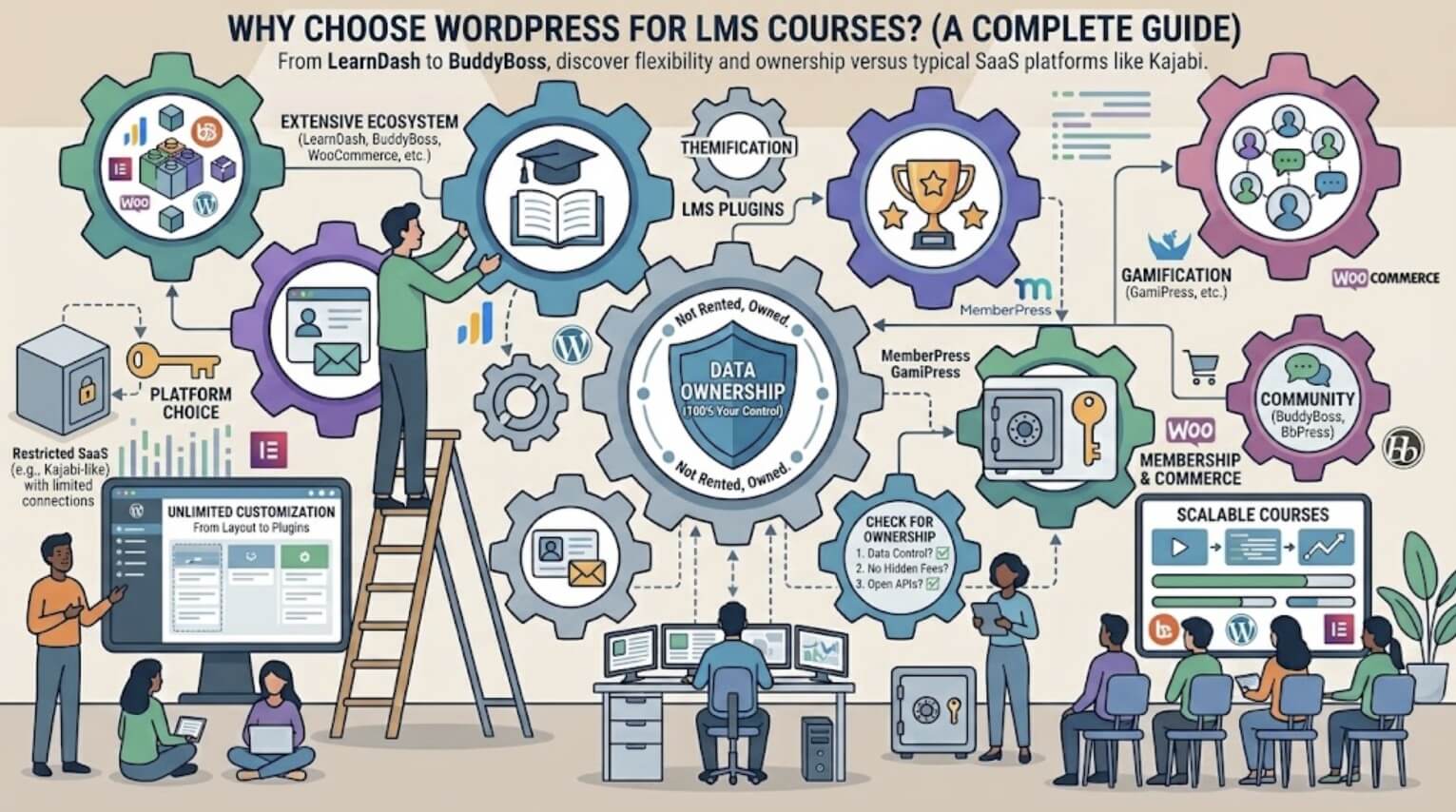

However, there are some very specific advantages to choosing WordPress, and that’s what this article is about.
WordPress vs Other Online Course Platforms
Before looking at what’s possible when building a course on WordPress, it’s important to understand what sets it apart from the other course platforms available today.
Most popular SaaS platforms operate like “walled gardens”. In other words, these companies build useful features that appeal to most course creators.
This means that, for most users, platforms like Kajabi, which come with sales funnels and solid email marketing tools alongside the courses themselves, work perfectly well.
However, when we talk about course architecture, social architecture, gamification, and custom projects, WordPress is now one of the best options available, going head-to-head with Moodle and winning in several areas, such as development cost, membership plans, automation, and more.
So WordPress is the perfect tool for anyone who needs to build a fully customised course platform.
The Real Advantages of WordPress for LMS
As I mentioned, you can build a 100% customised course with WordPress, and that’s one of the reasons some companies are migrating to this CMS.
WordPress works as an all-in-one platform, where you can easily bring together powerful features within the same ecosystem, in a modular way that’s far less rigid than SaaS tools, integrating everything relatively simply.
Let’s look at some of these possibilities.
Course Plugins
Plugins such as LearnDash, currently the most popular for WordPress, give you a whole range of features to build the perfect course.
What I like most about LearnDash is how customisable it is, along with the number of add-ons available for it. On top of that, developing specific features for LearnDash is relatively easy.
Say you want to create an interactive game inside a course (gamification) built with JavaScript and PHP, where the student earns points as they progress that can later be exchanged for rewards. Connecting all of this within LearnDash isn’t complicated at all.
LearnDash’s structure is also very intuitive for building advanced quizzes and assessments. The plugin has a genuinely intuitive builder for developing courses, lessons, topics and quizzes, making it easy to bring your idea from paper to reality.
It also integrates smoothly with Gutenberg or Elementor. To learn more about LearnDash’s structure, check out this complete guide.
Automation
With plugins like AutomatorWP or Uncanny Automator, you can set up countless triggers directly within WordPress, without needing external tools like Zapier.
So, for example, once a student watches a video in a lesson, you can have them automatically receive an email or a discount for another course. Or when they complete a module, they earn a badge or level up (gamification).
These plugins can integrate with more than 200 other plugins, such as Elementor, WooCommerce, ACF, and more. The possibilities are endless.
Gamification
Because WordPress gives you full access to the database, the REST API routes, and the hooks, you have much more freedom to build course gamification. Either by extending plugins like GamiPress, or by coding something from scratch that responds to student behaviour.
For example, you could create an in-course currency that students earn by progressing, getting good grades, and watching all the content, which they can later exchange for discount coupons on new courses, unlock one-to-one mentoring, or buy products within the site itself.
Several established platforms today, such as Duolingo, use gamification to keep users on the platform and motivate them throughout their learning journey.
And if your creativity allows, you could even build RPG-style games using tools like Claude and integrate them into your course, with the student progressing through levels linked to each module. This can be scaled in ways that are hard to measure.
Themification
This is the concept of creating a broad narrative that transforms the user experience and places them inside an immersive narrative universe, where the interface, language, gamification, interaction, and student progression are all shaped by a visual and conceptual theme.
Take a science course for children, for example: beyond videos and text, the whole theme and layout have a fun, animated feel. The student becomes a character and starts a learning journey where, to win a game, they first have to study.
As they move through each stage, the theme and the world created around them expand, making it feel like they’re part of a video game.
Most platforms have rigid themes that don’t allow this level of personalisation. Themification creates a unique, distinctive environment that helps the student learn and keep progressing, reinforcing the brand or idea in an authentic way.
Membership
WordPress’s membership architecture is extremely broad and, without doubt, the most flexible on the market.
With plugins like MemberPress, you can create complex combinations, such as monthly, annual, or six-monthly subscription packages, or 7-day trial subscriptions with limitations.
You can also build plans that give access to specific courses, and bundles with several courses together.
Combined with WooCommerce, you can create discounts for existing subscribers, or reward anyone who completes a course within 30 days with 30 days of free access to another course, and so on.
Community
If the last decade saw a boom in course creators, today the conversation has shifted to communities built around courses.
For WordPress, there are plugins like BuddyBoss or Fluent Community that let you build your own Facebook-style social network. This way, students can join groups and interact without feeling alone on the platform.
Say you’re building a training platform for new entrepreneurs. A community built into the courses is a great networking tool, encouraging idea-sharing, group tasks, and engagement.
On top of that, within the community itself, you can sell products directly to members, such as consulting, business planning, marketing campaigns, and more.
Niche communities are thriving this decade, and there’s a strong concentration of revenue within these groups. Communities also help reduce dropout rates in distance learning.
CRM
With a plugin like FluentCRM, you can share the same database as your other plugins, such as LearnDash, so events are added instantly.
For example, when student John ABC buys course XYZ, he’s added to a specific list within your CRM, and that list can be set up to trigger specific marketing campaigns. Now, once John finishes the course and hasn’t bought anything else, he can be moved to a list of prospects to re-engage.
What’s more, an integrated CRM doesn’t increase your costs based on the number of users. You could have a million contacts and still pay the same price.
Because the CRM sees everything the user does within the WordPress ecosystem, it’s easy to know, for example, the last time they logged in, and send them a fully personalised re-engagement email.
The CRM also handles all the marketing automation on the platform, such as user onboarding and engagement throughout the course.
Data Ownership
When you build your course on WordPress, everything created there is 100% yours. The database is yours.
On a SaaS platform, you’re taking on risk depending on the direction the company decides to take. If the SaaS company decides to raise its prices, goes bankrupt, or gets bought by another company, you have no control over those decisions.
What’s more, your course and student data end up belonging to a third party. Having this independence is essential if you’re aiming for growth and can’t afford to depend on someone else.
Final Thoughts
I could talk for hours about the various tools that make WordPress an all-in-one solution.
If you understand course architecture, you can build a platform that isn’t just excellent and different for the student, but also fully profitable.
Article written by Wellington Duarte from LearnDash Dev.


![[PRICE LIST] How Much Does a Website Cost in 2027?](https://freelance-webdesign.co.uk/wp-content/uploads/web-design-affordable-1-400x250.jpg)

0 Comments